Trailing Drawdown Explained: Why Traders Get Caught Off Guard
A trailing drawdown moves up as you win. Traders who treat it like a fixed limit get disqualified by a floor they did not know had moved. Here is how it works and how to track it.
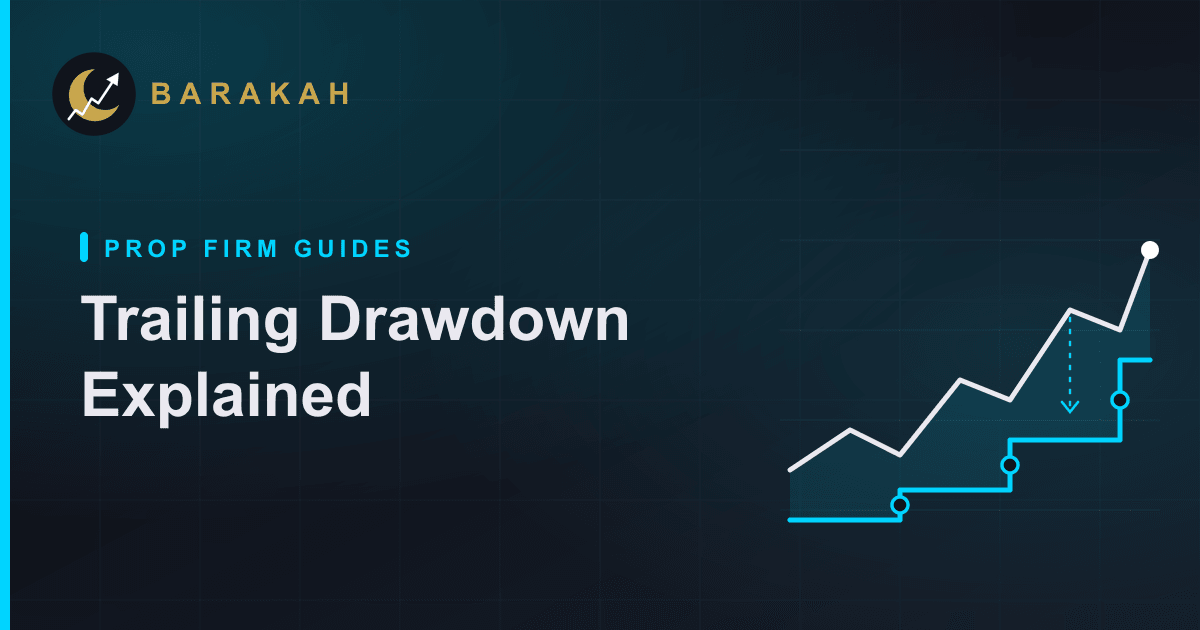
MyFundedFutures (MFFU) has grown fast among futures prop traders, and like most futures evaluation firms, its core risk rule is a trailing drawdown. Traders coming from static-drawdown firms or stock trading often misread how it moves, and that single misunderstanding accounts for a large share of avoidable disqualifications.
What "Trailing" Actually Means
A static drawdown sets one fixed floor for the life of the account. A trailing drawdown moves up as your account's balance (or, in some account types, your unrealized equity intraday) sets new highs, until it eventually locks once it reaches the starting balance. The practical effect: your risk cushion shrinks the more successful you are, right up until the rule stops trailing.
| Static drawdown | Trailing drawdown | |
|---|---|---|
| Floor | Fixed for the life of the account | Rises as your balance sets new highs |
| Locks? | Always fixed | Locks once it reaches the starting balance |
| Common mistake | None: the floor never moves | Tracking balance instead of the floor |
Why Traders Get Caught Off Guard
- They track account balance, not the trailing floor itself, and don't realize how close the two have become.
- They assume the drawdown is static because that's what a previous firm used.
- They let an open, unrealized gain swing back against them without realizing it counted toward their high-water mark.
- They increase size right after a strong day, not accounting for how much the floor moved up with it.
The Behavioral Trap Hiding Inside the Rule
Trailing drawdown rules punish a very specific behavior pattern: taking on more risk right after success. A trader who just had their best day of the month feels confident and sizes up, exactly when their trailing floor has moved closest to their balance and their margin for error is thinnest. This is a timing problem as much as a risk-management problem, and it's nearly impossible to catch by just glancing at a P&L number.
How to Trade a Trailing Drawdown Account With Discipline
- Know your current trailing floor at all times, not just your account balance.
- Build a personal rule for reducing size, not increasing it, after a strong day.
- Lock in gains by closing positions rather than holding unrealized profit that still counts toward your high-water mark.
- Review your sizing pattern weekly, specifically looking at how size changed in the 24 hours after a winning day.
This is the exact pattern (sizing up right after success) that a manual spreadsheet almost never catches in time, because the trader reviewing it is the same person whose confidence caused the problem. Our guide to choosing a prop firm trade journal covers what to look for instead.
How Barakah Closes This Gap
Barakah pulls your trailing drawdown floor directly from your connected broker data instead of relying on balance figures you enter yourself, so the floor stays accurate even as it moves. Its Behavioral Discipline Engine flags a post-win sizing shift the same day it happens, independent of how confident the trader feels in the moment, which is exactly the blind spot that causes most trailing-drawdown disqualifications.
That's the difference between a journal that logs what already happened and one that catches the pattern while there's still time to change it.
The Bottom Line
MyFundedFutures' trailing drawdown isn't harder to pass than a static one. It's just a different shape of risk, and most failures come from treating it like a rule you check occasionally rather than a floor you track continuously. Traders who track the floor itself, not just their balance, pass more consistently. New to futures evaluations? Start with the futures prop firm evaluation guide.
Frequently Asked Questions
What is a trailing drawdown?
A trailing drawdown is a loss limit that moves up as your account sets new highs, then locks once it reaches the starting balance. Your risk cushion shrinks as you become more successful, until the rule stops trailing.
What is the difference between a static and a trailing drawdown?
A static drawdown sets one fixed floor for the life of the account. A trailing drawdown rises with your balance (or, on some account types, your intraday unrealized equity) as it sets new highs.
When is a trailing drawdown account most at risk?
Right after your best day. The floor has moved up the most, your margin for error is thinnest, and confidence tempts you to size up.